For a detailed guide to different rainfall types and listening tips, read our complete guide to the best rain sounds for sleep.
Rain Sounds vs. White Noise for Sleep: Which Is Better?
For many people, turning on rain sounds or white noise has become part of a nightly routine, much like dimming the lights or putting away a phone before bed.
Both sounds may create a more consistent listening environment, but they do not sound the same and may not suit the same type of sleeper.
White noise is often chosen for its strong sound-masking ability. Rain sounds are usually preferred because they feel softer, more natural, and emotionally comforting.
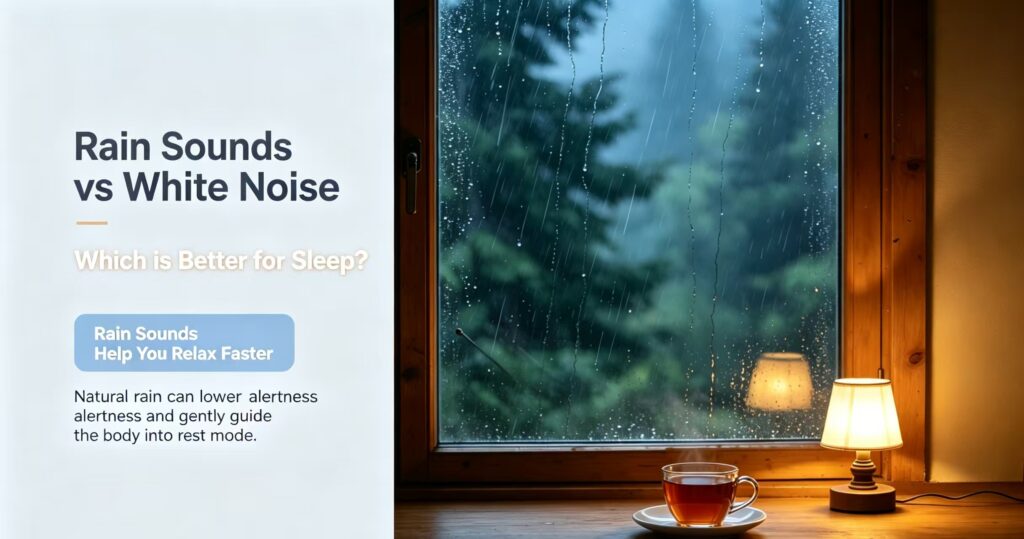
So, which one is better for sleep?
The most accurate answer is that neither option is universally superior. The better choice depends on the noise around you, your sensitivity to sound, and the kind of atmosphere that helps you relax.
Quick Answer
Choose white noise when your main goal is to mask unpredictable sounds such as traffic, conversations, doors closing, or barking dogs.
Choose rain sounds when you prefer a softer and more natural background that helps you relax without the sharper quality of traditional white noise.
Start at the lowest comfortable volume and try each sound for several nights before deciding which works better for you.
Are Rain Sounds the Same as Pink Noise?
Not exactly.
White noise and pink noise have precise technical definitions based on how sound energy is distributed across frequencies.
White noise contains equal power per unit of frequency. This produces the familiar steady hiss associated with radio static, air conditioners, or some sound machines.
Pink noise contains less energy at higher frequencies and relatively more energy in the lower-frequency range. It is therefore usually perceived as deeper and softer than white noise.
Some rain recordings may have pink-noise-like qualities, particularly when the rainfall is steady and contains few sudden changes. However, a natural rain recording is not automatically pink noise. Its frequency pattern depends on factors such as:
- Rain intensity
- Recording equipment
- Distance from the rain
- Whether rain falls on glass, metal, leaves, a roof, or the ground
- Background wind, thunder, and environmental sounds
A recording of rain is best described as a natural soundscape unless its frequency spectrum has actually been engineered or measured as pink noise.
How White Noise May Help With Sleep
White noise is primarily used for sound masking.
A sudden sound is more noticeable in a completely quiet bedroom because the difference between silence and the sound is large. A constant background sound reduces that contrast.
For example, white noise may make the following sounds feel less disruptive:
- Traffic outside a window
- Neighbors talking
- Doors opening and closing
- Household appliances
- Pets moving around
- Activity in a dormitory or shared home
White noise does not physically eliminate those sounds. Instead, it makes them less distinct against a stable auditory background.
This may be useful for people who live in noisy environments or who are frequently awakened by unpredictable sounds.
How Rain Sounds May Help With Sleep
Rain sounds can also mask background noise, although they are often less uniform than electronically generated white noise.
Their main appeal is usually their natural and calming character.
Steady rainfall may help create:
- A predictable sound environment
- A sense of comfort and shelter
- A relaxing bedtime cue
- A softer alternative to electronic static
- Gentle masking of moderate background noise
Many people also associate rain with being warm and safe indoors. These personal and emotional associations may make the sound more relaxing, even when the recording is not technically pink noise.
What Does the Research Say About White Noise?
Research into white noise as a sleep aid has produced mixed results.
A systematic review of auditory stimulation in adults found that white noise, pink noise, and related sound interventions have been studied in several settings, but differences in sound type, volume, participant groups, and sleep measurements make firm conclusions difficult.
Another systematic review focusing on continuous white or broadband noise concluded that the quality of available evidence was low and that more research using objective sleep measurements was needed before continuous noise could be broadly recommended as a sleep aid. The authors also noted that inappropriate or excessive sound exposure could potentially affect sleep or hearing.
Some individual studies have reported positive results in specific environments. For example, a randomized controlled trial in intensive-care patients found that white noise played at 40–50 decibels overnight for three consecutive nights improved subjectively reported sleep quality. However, results from a hospital setting may not apply directly to healthy adults sleeping at home.
Overall, white noise appears most plausible as a tool for masking environmental noise, rather than as a guaranteed method for improving sleep quality.
What Does the Research Say About Pink Noise?
Some small studies have explored whether carefully timed pink-noise stimulation can influence slow-wave sleep.
Researchers have tested short pulses of pink noise synchronized with the brain’s slow oscillations during deep sleep. Some studies reported increases in slow-wave activity and, in certain participants, improvements in next-morning memory performance.
However, this method is very different from playing a continuous pink-noise track from a phone or YouTube video.
The experimental stimulation was:
- Delivered in short pulses
- Timed to specific phases of brain activity
- Used under controlled laboratory conditions
- Tested in relatively small participant groups
It would therefore be inaccurate to claim that an ordinary continuous rain or pink-noise recording produces the same effects.
The broader evidence for continuous pink noise remains limited, and individual responses may vary.
Rain Sounds vs. White Noise
Rain sounds:
- Natural, textured, and gently varied
- Often chosen for relaxation and moderate sound masking
- Usually softer than traditional white noise
- Well suited to quiet or moderately noisy bedrooms
- May include distracting thunder, wind, birds, or changes in intensity
- Best for people who prefer natural ambience
White noise:
- Consistent, static-like, and uniform
- Often chosen for stronger masking of irregular sounds
- Contains more noticeable high-frequency sound
- Well suited to noisy apartments, dormitories, hospitals, or shared homes
- May sound harsh or tiring to some listeners
- Best for people who prioritize sound masking
Which Sound Is Better for Light Sleepers?
Light sleepers generally benefit from recordings without sudden changes.
A gentle rain recording may be suitable when it contains:
- No thunder
- No loud wind
- No animal calls
- No advertisements
- No abrupt loop points
- No sudden increase in rainfall intensity
White noise may be more useful when the bedroom contains frequent unpredictable noise. However, some sensitive listeners find its higher-frequency hiss uncomfortable.
The best option is the one that remains noticeable enough to mask distractions but quiet enough that it does not become a distraction itself.
Which Is Better for Blocking Traffic Noise?
White noise may be more effective when traffic sounds are irregular, particularly when cars, horns, or voices appear suddenly.
Rain sounds can also help, especially heavier roof rain or car-roof rain, but their effectiveness depends on the recording’s frequency range and volume.
For lower-pitched traffic rumble, some people may prefer pink or brown noise. For voices and sharper sounds, white noise may provide stronger masking.
No background sound can completely block loud environmental noise. Sealing windows, using curtains, moving the bed, or using comfortable earplugs may also be necessary.
How Loud Should Sleep Sounds Be?
There is no universally established ideal volume for every person, sound type, and bedroom.
Use the lowest volume that makes distracting noise less noticeable.
The sound should not:
- Feel intense or uncomfortable
- Cause ringing or pressure in the ears
- Prevent you from hearing alarms
- Require you to raise your voice
- Play loudly through headphones throughout the night
A speaker positioned away from the head is usually more comfortable than sleeping with in-ear headphones.
Should You Play the Sound All Night?
Some people prefer continuous sound because environmental noise continues throughout the night. Others only need support while falling asleep.
A timer may be a reasonable option when:
- Your bedroom becomes quiet later at night
- You only struggle during the first hour
- Continuous sound becomes irritating
- You want to limit overnight audio exposure
Try a timer of 30–60 minutes first. If outside noise repeatedly wakes you later, a quiet continuous recording may be more suitable.
A Simple Four-Night Test
You can compare the two options without relying on a single night.
Nights 1 and 2: Rain Sounds
Choose a steady recording without thunder or music.
Record:
- Approximate time needed to fall asleep
- Number of remembered awakenings
- How rested you feel in the morning
- Whether the sound felt comfortable
Nights 3 and 4: White Noise
Use a similar volume and follow the same bedtime routine.
Record the same observations.
At the end of the test, ask:
- Which sound felt less distracting?
- Which masked the bedroom noise more effectively?
- Which helped you relax faster?
- Which one would you be comfortable using regularly?
This is not a medical experiment, but it may help you identify your personal preference.
Frequently Asked Questions
Is rain sound better than white noise for sleep?
Rain may feel more relaxing and natural, while white noise may provide stronger masking. The better option depends on your environment and personal sound preference.
Is rain technically pink noise?
Some steady rain recordings may have pink-noise-like characteristics, but natural rain is not automatically or precisely pink noise.
Can white noise improve deep sleep?
There is not enough consistent evidence to say that ordinary continuous white noise reliably increases deep sleep. Its clearest practical role is masking disruptive environmental sound.
Can pink noise increase deep sleep?
Laboratory studies have found that precisely timed pink-noise pulses can increase slow-wave activity under controlled conditions. This should not be interpreted as proof that continuous pink noise or rain recordings produce the same effect.
Is it safe to listen every night?
Low-volume background sound may be comfortable for many adults, but excessive volume or prolonged headphone use may be harmful. Stop using the sound if it causes discomfort, ringing in the ears, headaches, or poorer sleep.
Final Verdict
There is no universal winner in the comparison between rain sounds vs. white noise for sleep.
Choose white noise when you need a consistent acoustic shield against unpredictable environmental sounds.
Choose rain sounds when your primary goal is relaxation and you prefer a softer, more natural atmosphere.
Whichever sound you select, keep the volume low, avoid sudden changes, and judge the result by how you actually sleep—not by the name or color of the noise.
Persistent insomnia, loud snoring, breathing interruptions, or severe daytime tiredness should be discussed with a qualified healthcare professional.
Still deciding which type of rainfall suits you? Explore our guide to the best rain sounds for sleep, including window rain, roof rain, forest rain, and distant thunder.
Pingback: Best Rain Sounds for Sleep: Types, Benefits & Listening Tips