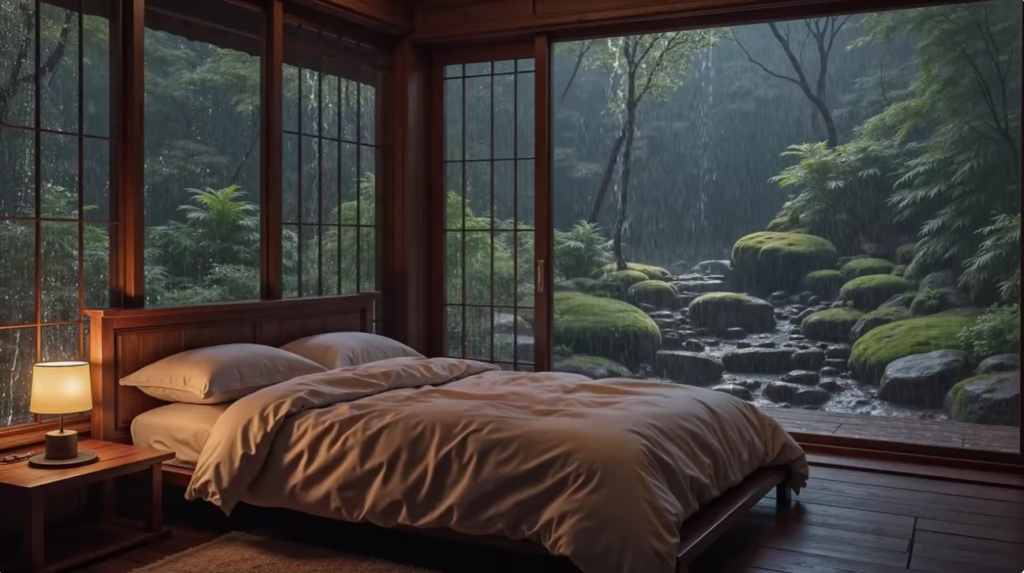
When I was a kid, my parents would leave early for work every summer morning, and I’d be home alone for the day. On countless afternoons, I fell asleep to the sound of rain outside my window — summer rain came fast and heavy, drumming loudly against the windowsill, while spring brought something gentler, a soft drizzle that just kept going, quietly, for hours. Either way, what I loved most was lying in bed, pulling my little blanket in close, and drifting off to the sound of it falling — sometimes a gentle light rain, sometimes a much heavier rain pounding the glass
It wasn’t until I got older that I understood why. That sense of calm wasn’t just in my head — different intensities of rain actually seem to affect us in different ways. So which one really helps you fall asleep faster: light rain or heavy rain?
What Makes Light Rain Different
Light rain has a soft, sparse quality — individual drops are often distinguishable, landing with a gentle, irregular patter. Because the sound sits at a lower overall volume and has more natural gaps between drops, it tends to feel unobtrusive, like a background texture rather than something that demands attention.
Light rain tends to work well for:
- Sensitive sleepers who wake easily at louder or sudden sounds
- Quiet bedrooms where you don’t need much noise masking
- People who find heavier sounds slightly overstimulating right before bed
- Falling asleep gradually, since the sound rarely changes in intensity
What Makes Heavy Rain Different
Heavy rain is louder, denser, and far more continuous — the individual drops blur together into a steady wall of sound, sometimes layered with wind or distant thunder. This density is exactly what makes it effective at masking other noise: a much louder, broader sound simply leaves less room for outside disturbances to break through.
Heavy rain tends to work well for:
- People in noisy environments (busy streets, apartment buildings, snoring partners)
- Listeners who find a fuller, more immersive sound more relaxing than a sparse one
- Anyone who struggles to “switch off” a racing mind — the density of heavy rain gives the brain more to settle into
- Longer, deeper sleep stretches once you’re already asleep, since it maintains a very consistent noise floor
Light Rain vs. Heavy Rain: A Side-by-Side Comparison
| Light Rain | Heavy Rain | |
|---|---|---|
| Volume & density | Soft, sparse, gaps between drops | Loud, dense, continuous |
| Best for | Quiet rooms, sensitive sleepers | Noisy environments, strong masking needs |
| Noise masking ability | Mild | Strong |
| Risk of overstimulation | Low | Slightly higher for some listeners |
| Typical use case | Falling asleep gently | Blocking out a loud environment |
So Which One Actually Helps You Fall Asleep Faster?
There’s no single answer that works for everyone — but there is a useful rule of thumb: your ideal rain intensity usually mirrors how noisy your environment already is.
If your bedroom is already fairly quiet, a loud downpour can feel like it’s competing with the silence rather than blending into it, which may actually draw more attention than it hides. In that case, light rain is often the more natural fit — it adds just enough sound to keep your brain from fixating on small noises, without overpowering the room.
If you live somewhere noisy — city traffic, thin walls, a partner who snores — light rain often isn’t loud enough to do its job. The disturbances still poke through. Heavy rain’s density gives you a much higher “masking ceiling,” covering a wider range of competing sounds.
There’s also a psychological angle: some people find sparse, gentle sounds more calming because there’s less for the brain to process, while others find a fuller sound more absorbing precisely because it gives an anxious mind something substantial to focus on instead of looping thoughts.
A Simple Way to Test Which One Works for You
- Try light rain for one nap or one night’s sleep
- Try heavy rain on a different night, ideally under similar conditions
- Notice which one you stop consciously hearing sooner — the sound that “disappears” fastest as you drift off is usually the one your nervous system responds to best
It’s also worth testing at different times of year — if your environment gets noisier in some seasons (open windows in summer, storms, traffic changes), your ideal intensity might shift too.
The Middle Ground: Moderate Rain
If neither extreme feels quite right, moderate rain — steady but not overwhelming — is a common default that works reasonably well across most environments. Many listeners find it’s the safest starting point before fine-tuning toward lighter or heavier depending on how the first few nights go.
Final Thoughts
Neither light rain nor heavy rain is objectively “better” for sleep — the right choice depends on your environment, sensitivity to sound, and what your mind naturally responds to. The good news is that testing both costs nothing but a couple of nights, and once you find your fit, it’s an easy, equipment-free habit to build into your routine.
Curious which one our audience prefers? We recently asked the same question — check out the light rain vs. heavy rain comparison on our YouTube channel, and explore our full library of rain sounds, including car rain and tent rain, at [our YouTube channel] or in our [Recommended Sleep Setup] guide.